
On this page
For many runners, 500–800 km (roughly 300–500 miles) is a sensible point at which to inspect a pair more carefully. It is not a fixed expiry date. A shoe’s construction, your body weight, running surface, weekly mileage, gait, weather and the type of training you do all influence how quickly it changes.
The most useful question is not simply “How old are my trainers?” but “Do the fit, cushioning, grip and feel still match what I ask this pair to do?”
When should you change your running trainers?
Start inspecting your main running pair once it approaches 500 km. If you run 25 km each week, that is roughly five to six months; if you run less often, the same distance may take much longer. Keep a simple note in your running app or on your phone so mileage does not become guesswork.
Research does not support one universal distance at which every runner becomes more likely to get injured. A study of recreational runners found that pressure beneath the midfoot increased after extended use, while other areas of the pressure pattern remained broadly stable after 700 km. That is a reason to monitor your shoes, not proof that 700 km is a dangerous cut-off [1].
Why do running shoes change with use?
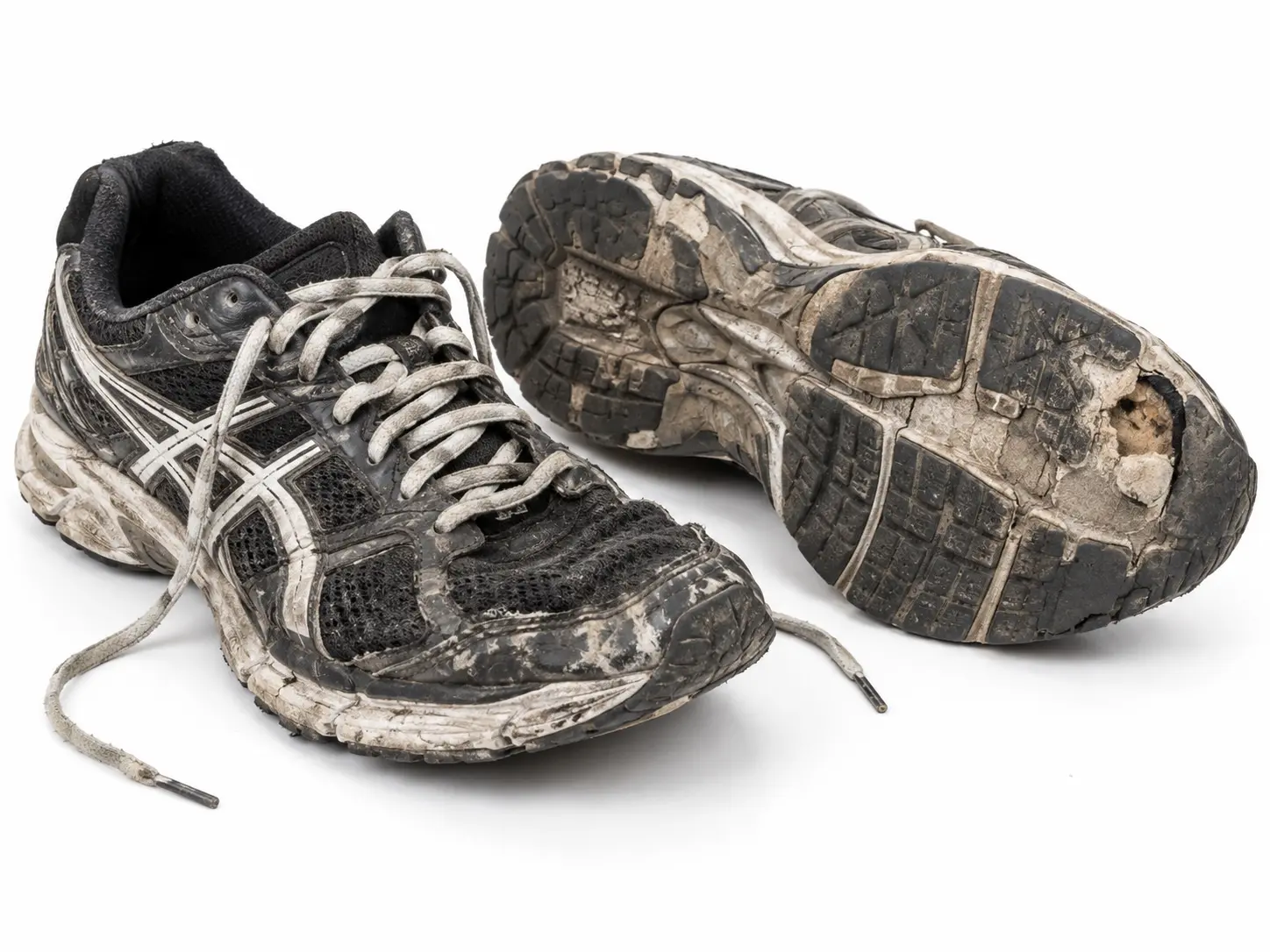
Every step compresses the midsole. Over time, foam can lose some of its original response, while the outsole gradually loses grip and the upper stretches or creases. The shoe may still look presentable, but it can feel less supportive, less predictable or less comfortable.
Worn footwear does not automatically cause an injury, and a newer shoe is not automatically safer. The value of replacement is that it restores a familiar fit and mechanical feel when the current pair no longer provides it. When choosing the next pair, comfort and a good fit are useful starting points; changing to a very different shoe should be gradual.
Think in patterns, not single symptoms: visible wear plus a flatter feel plus new, repeatable discomfort is more meaningful than any one sign on its own.
What signs suggest it is time for a new pair?
- Uneven or substantial outsole wear. One side is noticeably more worn, or the tread no longer grips reliably.
- A flattened or heavily creased midsole. The cushioning feels less springy or noticeably different from when the shoes were new.
- A poorer fit. Your heel slips, the upper has stretched or your foot moves inside the shoe.
- A changed running experience. A familiar route leaves your feet or legs unusually uncomfortable and the shoes also show signs of wear.
If the shoes are worn but comfortable, they may still be suitable for walking or light gym work. Reserve a newer pair for the activity that places the greatest demand on them.
Can worn trainers cause calf pain?
Your calf muscles help control the ankle and contribute to the push-off phase of running. Footwear can be part of the context, but calf pain alone does not prove that your trainers are worn out. A sudden increase in distance, faster running, hills, a new surface, reduced recovery or a large change in footwear can all alter the load placed on the calf and Achilles tendon.
Review what changed in the preceding days and whether the symptoms are improving with sensible activity modification. If you replace your trainers, introduce the new pair over a few shorter runs rather than making an abrupt switch during a demanding week.
Can massage help if your calves are sore?
For familiar, diffuse muscle soreness after a harder or unfamiliar workout, massage may make the area feel more comfortable. A systematic review and meta-analysis of 29 studies involving 1,012 participants found that sports massage was associated with a small improvement in delayed-onset muscle soreness, although the results varied considerably between studies. It did not show a direct improvement in strength or sporting performance [2].
That makes massage a reasonable option for symptom relief alongside sensible changes to training, sleep and recovery. It does not restore worn shoe cushioning, repair a tendon tear or diagnose the reason pain keeps returning. An assessment is more useful when pain is persistent, localised, worsening or affecting your running pattern.
Massage is one part of recovery: it may reduce the feeling of post-exercise soreness, but the longer-term answer usually includes an appropriate training load and gradual capacity building.
When should calf pain be checked before massage?
Do not massage unexplained one-sided calf pain with swelling, warmth, redness or a change in skin colour. Contact NHS 111 or seek an urgent GP appointment, because these symptoms can be associated with a deep-vein thrombosis. If calf symptoms occur with chest pain or sudden shortness of breath, call 999.
A sudden snap or pop followed by marked pain, bruising, difficulty walking or difficulty rising onto your toes also needs prompt medical assessment, as it may indicate an Achilles injury.
Replace the evidence, not the calendar.
Start checking your running trainers at around 500 km, and use 500–800 km as a review range. Replace the pair when wear, fit and feel tell a consistent story. If your calves hurt, consider recent training and footwear changes as well as the symptoms themselves. Massage may ease ordinary post-exercise soreness once more serious causes have been considered.
Two useful papers
- Escamilla-Martínez E, Gómez-Martín B, Fernández-Seguín LM, et al. Longitudinal Analysis of Plantar Pressures with Wear of a Running Shoe. International Journal of Environmental Research and Public Health. 2020;17(5):1707. Read on PubMed ↗
- Davis HL, Alabed S, Chico TJA. Effect of sports massage on performance and recovery: a systematic review and meta-analysis. BMJ Open Sport & Exercise Medicine. 2020;6:e000614. Read the paper ↗
This article is for general education and does not replace an individual clinical assessment.