
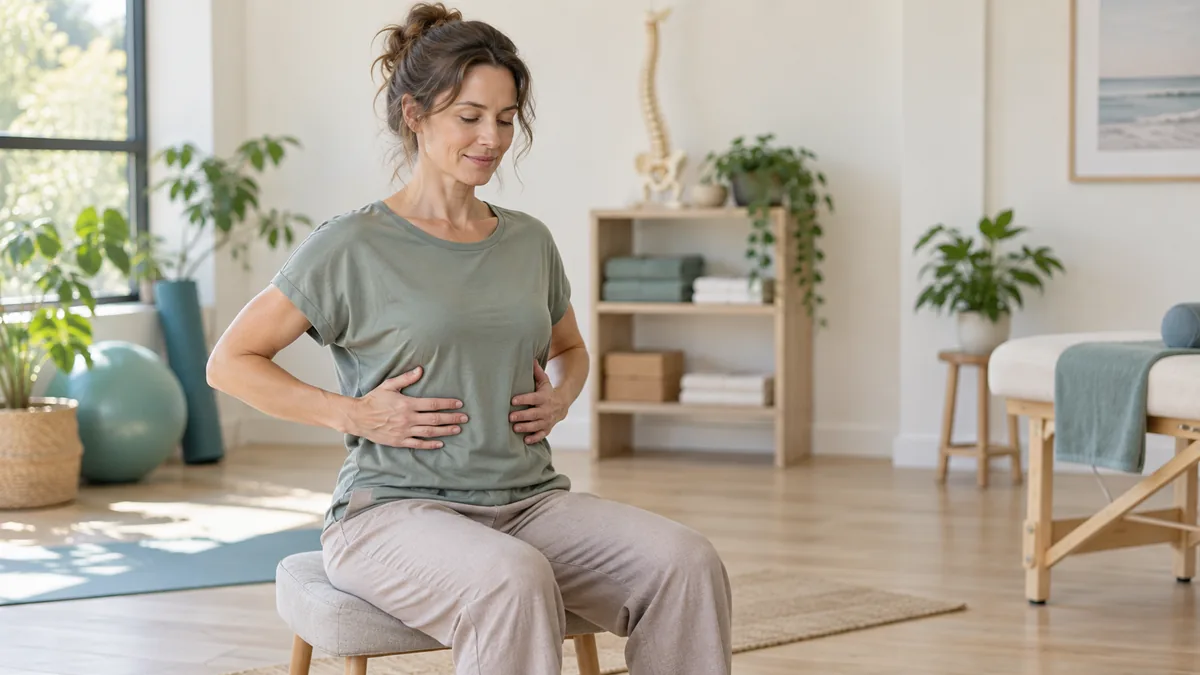
A comfortable breath involves more than your lungs.
Your diaphragm, ribs, abdominal wall and spine work together with every inhale and exhale. Understanding this movement helps explain why breathing can feel restricted when your body is tense—and why breathing exercises and carefully chosen hands-on treatment may support comfort and wellbeing.
The muscle beneath every breath
The diaphragm is a dome-shaped muscle separating the chest from the abdominal cavity. It attaches to the lower tip of the breastbone, the inner surfaces of the lower six ribs and their cartilage, and the upper lumbar vertebrae through muscular attachments called the crura. Its fibres converge into a central tendon.
Make room.
The diaphragm contracts and descends, expanding the chest and lowering pressure around the lungs. Pressure inside the lungs briefly falls below atmospheric pressure, drawing air in.
Let go.
During a relaxed exhale, the diaphragm releases and rises as the lungs recoil, allowing air to leave.
As the diaphragm descends, it gently displaces the abdominal contents, usually increasing abdominal pressure as the abdominal wall accommodates the movement. These coordinated pressure changes also contribute to trunk support. Together with the abdominal muscles, pelvic floor and spinal muscles, the diaphragm helps your body manage breathing and movement.
When the rib cage feels restricted
The intercostal muscles sit between the ribs and help control chest-wall movement. Pain, muscle guarding or stiffness around the ribs can make expansion less comfortable, encouraging smaller breaths. However, feeling “tight” does not necessarily mean your lungs have lost capacity or that your oxygen levels are low.
The thoracic spine and rib cage form a protective framework around the heart and lungs. This gives the region considerable stability, while still allowing the movement needed for breathing, reaching and turning.
When chest movement feels limited, some people rely more heavily on muscles around the upper chest and neck. The scalenes and sternocleidomastoid can assist inhalation; sustained extra effort may contribute to neck and shoulder fatigue.
Breathing, back and neck pain
The neck, thorax and lower back share movement demands through joints, muscles and connective tissues, including fascia. Reduced movement in one region may change how neighbouring areas move or work.
This offers a plausible explanation for some compensatory tension, but anatomical connections do not prove that a tight diaphragm causes neck pain or lower back pain. Pain can also change breathing; stress, sleep, activity and previous injury matter.
A systematic review and meta-analysis of 13 trials involving 677 participants found improvements in pain and disability in people with chronic low back pain. Some respiratory measures also improved. These findings support breathing exercises as a possible addition to rehabilitation—not proof that faulty breathing caused the pain (Jiang et al., 2024).
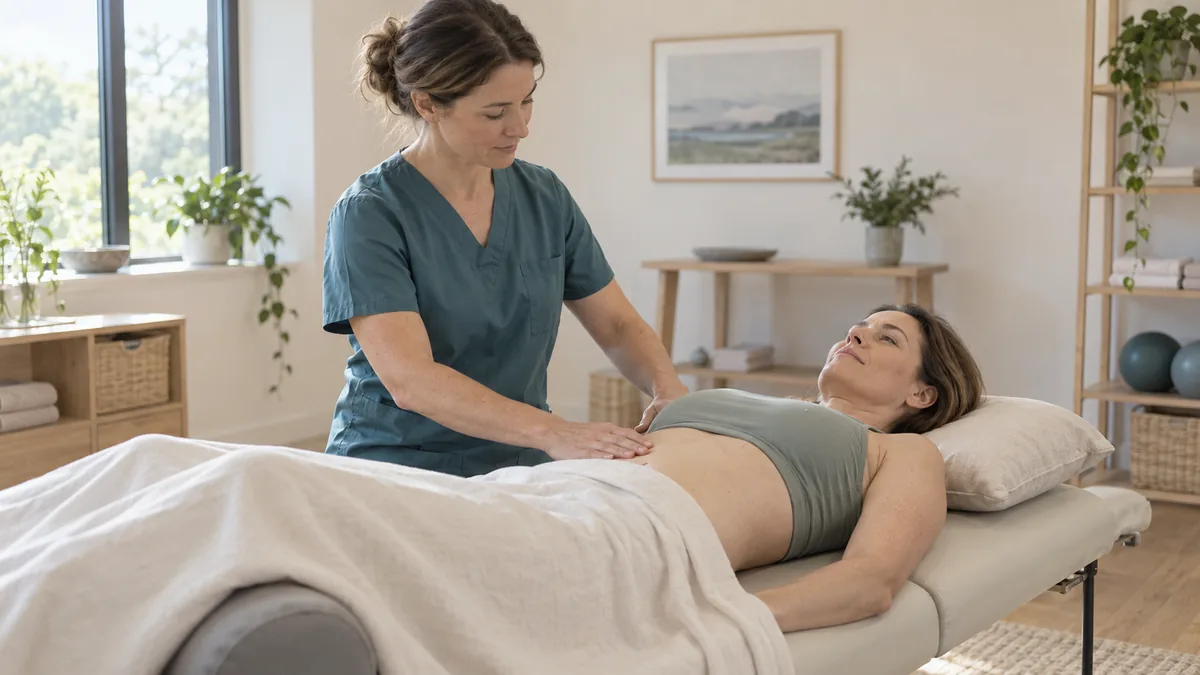
Can massage and diaphragm work help?
Hands-on treatment may be considered when tenderness or restricted movement makes breathing uncomfortable. Depending on assessment, this might include gentle work around the lower rib margins, soft-tissue techniques for the intercostal and chest muscles, and movement of the ribs or shoulder blades.
Abdominal massage may be used for comfort where appropriate and with consent. However, abdominal massage and shoulder-blade mobilisation should not be presented as proven ways to improve diaphragm function: evidence for these specific effects remains limited.
A systematic review of manual techniques directed at the diaphragm reported immediate improvements in diaphragm mobility and chest–abdominal expansion, alongside some improvements in flexibility. Evidence for pain relief and lasting benefits was more limited, with further research needed in people with symptoms (Fernández-López et al., 2021).
The aim is easier breathing and movement, reinforced through activity and appropriate exercise. Treatment should remain comfortable; forceful pressure beneath the ribs is unnecessary.
Breathing as a moment of recovery
Comfortable, controlled breathing may help reduce stress. A meta-analysis found small-to-moderate improvements in self-reported stress compared with control conditions, although study limitations require cautious interpretation (Fincham et al., 2023).
One or two quiet minutes
Sit comfortably or lie with your knees supported. Rest your hands around your lower ribs. Breathe gently through your nose, allowing the ribs to widen and the abdomen to move naturally. Let the exhale leave without pushing.
Keep your shoulders relaxed. Aim for ease rather than the biggest possible breath. Stop if you become dizzy or uncomfortable.
Breathing practice can be part of caring for your body, alongside regular movement and individually tailored treatment.
New or unexplained breathlessness, chest pain or significant pain with breathing needs medical assessment rather than an assumption of muscle tension.
Research & references
- Fernández-López, I., Peña-Otero, D., Atín-Arratibel, M.Á. and Eguillor-Mutiloa, M. (2021) ‘Effects of manual therapy on the diaphragm in the musculoskeletal system: A systematic review’, Archives of Physical Medicine and Rehabilitation, 102(12), pp. 2402–2415. doi: 10.1016/j.apmr.2021.03.031.
- Fincham, G.W., Strauss, C., Montero-Marin, J. and Cavanagh, K. (2023) ‘Effect of breathwork on stress and mental health: A meta-analysis of randomised-controlled trials’, Scientific Reports, 13, article 432. doi: 10.1038/s41598-022-27247-y.
- Jiang, X., Sun, W., Chen, Q., Xu, Q., Chen, G. and Bi, H. (2024) ‘Effects of breathing exercises on chronic low back pain: A systematic review and meta-analysis of randomized controlled trials’, Journal of Back and Musculoskeletal Rehabilitation, 37(1), pp. 13–23. doi: 10.3233/BMR-230054.
General information, not a diagnosis or an individual treatment plan.